Internship

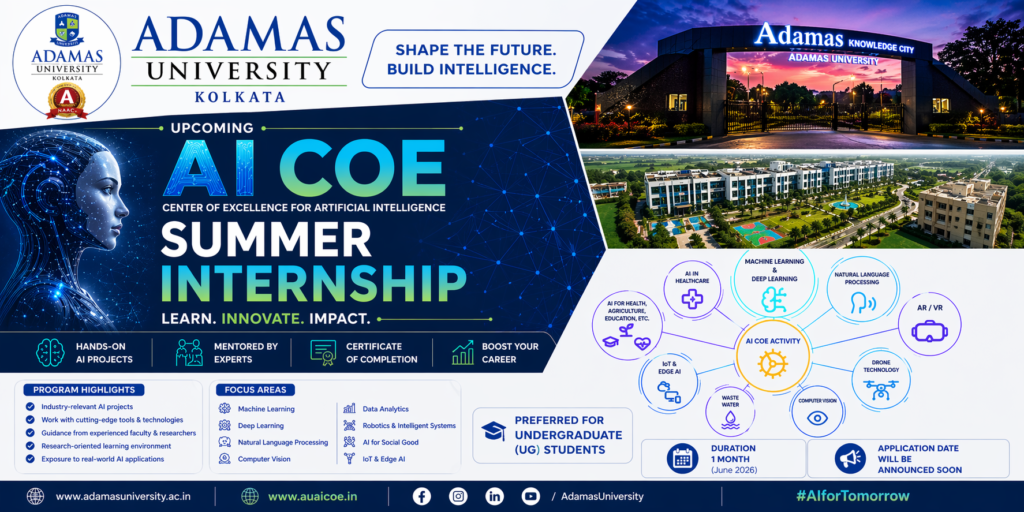
AI Center of Excellence Summer Internship 2026 banner

AI Center of Excellence, Adamas University

AI CoE Summer Internship 2026

A focused, domain-based project internship where selected students choose one primary technology track, build deeply under mentor guidance, and finish with a portfolio-ready project, GitHub repository, technical report, and Demo Day presentation.

Domain-based specialization Hands-on lab work Mentor-led execution Final live demonstration
1 Month 4-week structured internship timeline
5 Domains Full Stack, HPC, Unstructured Database, Deep Learning, and Gen AI
~50 Students Suggested intake through interest, preparation, and mentor capacity
Project First Working prototype, documentation, report, presentation, and evaluation

Program Model

Designed for depth, realistic learning, and measurable outcomes.

The revised internship model avoids superficial exposure to many technologies in a short period. Each student selects one focused domain and completes a guided internship project aligned with industry, research, innovation, and AI CoE development needs.

01

Help students learn deeply in one selected domain instead of briefly touching many advanced technologies.

02

Build hands-on skills in modern computing domains relevant to industry and research practice.

03

Guide students toward portfolio-ready projects, GitHub documentation, and final demonstrations.

04

Create a student pipeline for AI CoE projects, research assistance, and innovation activities.

05

Encourage interdisciplinary work across AI, software systems, databases, HPC, and Generative AI.

Internship Domains

Students select one primary track and build a complete project in that domain.

Each track has mentor-led sessions, practical work, weekly review, and a final output. Cross-domain collaboration may be encouraged where feasible, such as Full Stack + Gen AI, Deep Learning + HPC, or Unstructured Database + RAG.

Full-Stack Software Development

Focus AreaWeb application design, frontend, backend, REST APIs, deployment.

ToolsHTML, CSS, JavaScript, React, Node.js/Express, FastAPI, GitHub, Docker basics.

Expected OutputA deployable web application with clean UI, backend APIs, and documentation.

High Performance Computing

Focus AreaLinux, parallel computing, GPU/HPC workflows, and performance benchmarking.

ToolsLinux, Bash, Python, NumPy, multiprocessing, CUDA concepts, SLURM/HPC job submission.

Expected OutputA benchmarked computing workflow or accelerated mini-project.

Unstructured Database

Focus AreaNoSQL data modelling, document stores, vector databases, and retrieval systems.

ToolsMongoDB, Firebase basics, Elasticsearch concepts, Chroma/FAISS, JSON, APIs.

Expected OutputA data-driven application using document, vector, or unstructured storage.

Deep Learning

Focus AreaNeural networks, computer vision/NLP basics, model training, and evaluation.

ToolsPython, PyTorch/TensorFlow/Keras, OpenCV, scikit-learn, Google Colab/HPC GPU.

Expected OutputA trained deep learning model with evaluation and a demo notebook or interface.

Generative Artificial Intelligence

Focus AreaPrompt engineering, LLM APIs, RAG, AI agents, and Gen AI applications.

ToolsOpenAI/Gemini APIs, LangChain/LlamaIndex basics, vector databases, Streamlit/FastAPI.

Expected OutputA Gen AI application such as a chatbot, RAG assistant, or document analyzer.

4-Week Structure

A clear path from setup to final demonstration.

All students begin with common foundations, then continue through domain fundamentals, implementation, integration, testing, documentation, and final project presentation.

Orientation and Repository Setup

AI CoE introduction, domain allocation, Git/GitHub, coding environment, problem understanding, tool setup, and initial repository.

Mentor-Led Implementation

Hands-on sessions, practice tasks, domain fundamentals, and early prototype or mini assignment submission.

Integration and Review

Debugging, documentation, advanced domain topics, project integration, and working project draft review.

Final Refinement and Demo

Testing, deployment or benchmarking, final documentation, presentation preparation, live demonstration, and evaluation.

Detailed Weekly Syllabus

Track-wise learning topics, practical work, and weekly outputs.

The syllabus keeps the internship practical: each week produces visible progress, from first prototype to final report and demonstration.

Track Week 1 Week 2 Week 3 Week 4
Full-Stack Frontend basics, HTML/CSS/JavaScript, UI planning, Git workflow; first frontend prototype. React components, routing, forms, REST APIs, backend routes; functional frontend-backend connection. Database integration, authentication basics, file/API integration, error handling; CRUD prototype. Deployment basics, testing, README writing, final UI refinement; documented final web app.
HPC Linux commands, shell scripting, Python performance basics, HPC architecture; benchmark readiness. Parallel computing, multiprocessing, vectorization, memory/runtime measurement; comparison report. GPU/HPC workflow concepts, CUDA overview, scheduling and profiling; optimized workflow draft. Benchmarking, speedup visualization, documentation, and final benchmark-based mini-project.
Unstructured Database Structured, semi-structured, and unstructured data; JSON and document modelling. MongoDB/Firebase, CRUD, indexing, API connection; database-backed prototype. Text handling, search, embeddings, vector databases, retrieval; search/retrieval prototype. Validation, dashboard/API integration, documentation, and final database-driven project.
Deep Learning ML vs DL, tensors, datasets, train-test split, evaluation metrics; dataset-ready notebook. Neural networks, activation, loss, optimizer, overfitting and regularization; baseline model. CNN/RNN/Transformer overview, transfer learning, evaluation; improved model with metrics. Model saving, inference, visualization, report writing, and final demo.
Gen AI LLM concepts, prompt engineering, responsible AI basics, API setup; interaction workflow. Application integration, chat interfaces, prompt templates, response formatting; AI assistant prototype. RAG pipeline, embeddings, chunking, vector database, retrieval quality; document Q&A prototype. Evaluation, guardrails, deployment/demo, documentation, and final Gen AI application.

Foundation and Execution

Common training keeps every track disciplined and transparent.

Before specialization, students align on workflow, tools, scope, documentation, and evaluation. Progress checks may be maintained through GitHub commits, task sheets, or mentor review logs.

Orientation and domain selection Git, GitHub, VS Code setup Python/Node environments Debugging and coding standards One-page project plan

Deliverables

Every student or team finishes with evidence of real work.

The internship emphasizes demonstrable outcomes that can support internships, placements, higher studies, research applications, and future AI CoE project development.

Required Student Deliverables

  • A working internship project or prototype in the selected domain.
  • A GitHub repository with source code, README, installation steps, screenshots, and results.
  • A short technical report covering objective, methodology, tools, results, and limitations.
  • A final presentation and live demonstration during Demo Day.
  • A mentor evaluation sheet covering attendance, task completion, and project quality.

Certificate Eligibility

  • Minimum attendance as decided by AI CoE.
  • Completion of weekly tasks or equivalent mentor-approved progress.
  • Submission of final GitHub repository, report, and presentation.
  • Participation in final Demo Day evaluation.

Suggested Project Themes

Sample ideas students can adapt into scoped internship projects.

Projects may be selected based on student interest, prior knowledge, mentor guidance, available infrastructure, and feasibility within four weeks.

Full-Stack

  • Internship management portal
  • Smart attendance dashboard
  • Research project tracker
  • Event registration system

HPC

  • Matrix multiplication benchmarking
  • Parallel image processing
  • GPU vs CPU performance study
  • HPC job monitoring dashboard

Unstructured Database

  • Document search system
  • JSON academic record manager
  • Vector search over PDFs
  • Log analytics dashboard

Deep Learning

  • Image classification
  • Object detection demo
  • Time-series prediction
  • Sentiment or anomaly detection

Gen AI

  • RAG chatbot for institutional documents
  • Resume analyzer
  • AI study assistant
  • Research paper summarizer

Evaluation Framework

Assessment is based on participation, weekly progress, implementation quality, and final demonstration.

Evidence may include session participation, mentor feedback, GitHub commits, assignment submissions, working code, architecture, results, documentation, installation guide, screenshots, final PPT, live demo, and Q&A performance.

Rubric Weightage

Attendance and Discipline
10%
Weekly Assignments
20%
Technical Implementation
30%
Innovation and Problem Relevance
15%
Documentation and GitHub Quality
10%
Final Demo and Presentation
15%

Demo Day

The final review gives students a professional project presentation experience.

Students present the problem statement, motivation, technical architecture, implementation challenges, and results through a live demonstration or recorded backup demo. The evaluation panel conducts Q&A and provides feedback. Top projects may be selected for further AI CoE development or publication-oriented extension.

Expected Outcome

Students gain depth in one selected technology domain, build demonstrable prototypes, and leave with portfolio-ready work suitable for internships, placements, higher studies, and research applications. The model also helps AI CoE scale future batches by domain demand and mentor availability.

Focused learning. Better mentoring. Stronger final projects.